

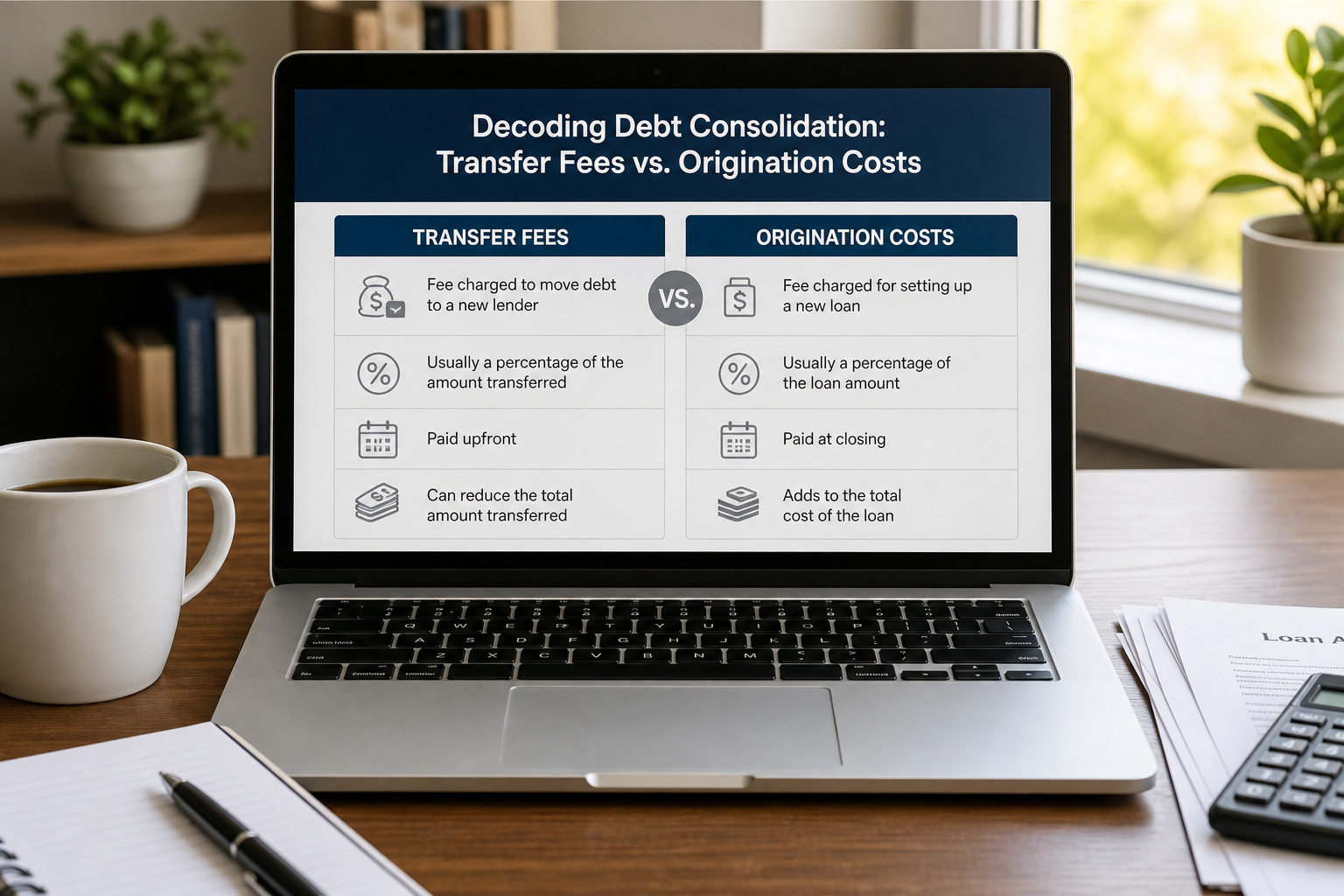
In today’s economy, where credit card APRs hover above 20% and banks tighten their lending criteria, it’s crucial to approach debt consolidation with a strategic mindset. Whether you’re considering a fixed-rate personal loan or a revolving line of credit, understanding the nuances between transfer fees and origination costs can make a significant difference in your overall financial health. This article will decode these costs to help you make informed decisions about the best debt consolidation strategies for your unique situation.
Understanding Transfer Fees: Are They Worth the Cost?
When considering a balance transfer credit card, typically offering a 0% introductory APR, it’s essential to evaluate the transfer fees, which usually range from 3% to 5% of the amount transferred. For instance, if you’re looking to consolidate $12,000 of credit card debt, a 3% transfer fee would cost you $360 upfront. While this may seem manageable, the real question is whether the cost of this fee outweighs the savings gained from the zero-interest period.
Many consumers fall into the trap of only focusing on the promotional rate without fully assessing the timeline of their debt repayment. With a standard 18-month promotional period on a balance transfer credit card, you’ll need to pay off that $12,000 before the APR returns to a potentially steep rate—often over 20%. If you can pay off the debt within that window, the transfer fee becomes a small price to pay for the potential savings. However, if you miss the deadline, the accrued interest can quickly negate any initial savings.
It’s essential to consider your repayment strategy and cash flow when weighing the transfer fee against the expected interest savings. For disciplined borrowers with a stable income, a balance transfer can be a powerful tool for debt elimination. However, those who struggle to adhere to a strict repayment schedule may find themselves facing a larger financial burden once the promotional period ends.
Evaluating Origination Costs: Hidden Fees in Debt Solutions
Origination fees are another cost to consider when looking at fixed-rate personal loans. These fees, which can range from 1% to 5% of the loan amount, are charged by lenders for processing the loan. If you were to take out a $12,000 personal loan with an origination fee of 4%, you’d be paying an additional $480, pushing your total loan amount to $12,480. While this fee is up-front, it can often be rolled into the loan amount, allowing you to mitigate immediate cash flow concerns.
When evaluating whether a personal loan is the right move, it’s also vital to look at the interest rates attached. For example, if you secure a personal loan with an APR of 11.5% over 36 months, your total repayment will amount to about $15,628, including the origination fee. Compared to the balance transfer option, where the total cost depends on how quickly you can pay off the debt, the personal loan offers a predictable payment schedule, which can be beneficial for your cash-flow management.
Moreover, fixed-rate personal loans can cater to a broader range of borrower profiles. They are particularly well-suited for those with moderate to low FICO scores who may not qualify for the best balance transfer offers. Additionally, for borrowers who prefer the certainty of fixed payments, this route can provide peace of mind compared to the potential unpredictability of a balance transfer’s promotional period.
Ultimately, the decision between utilizing a balance transfer credit card with transfer fees or a fixed-rate personal loan with origination costs hinges on your financial habits and repayment capabilities. By carefully analyzing your options, you can make a strategic move that not only consolidates your debt but also places you on a clearer path to financial freedom. Always calculate the total cost of each option, including fees and interest, to ensure you choose the best path for your individual circumstances.